For delivery driver insurance on a pay-as-you-go basis, you buy hire and reward cover for the periods you’re working rather than relying on standard private car insurance, which doesn’t cover paid deliveries. If you deliver for Deliveroo by car or motorised scooter, you need both Social, Domestic & Pleasure insurance for everyday use and Hire and Reward insurance for delivery work. This guide explains what food delivery cover can include, how pay-as-you-go policies track working time, why hire and reward matters, and which drivers and vehicles may be eligible, so you can understand the key differences before choosing cover.
Key Takeaways
- Separate everyday driving from paid delivery work: Social, Domestic & Pleasure cover and Hire and Reward cover apply to different uses.
- Pay-as-you-go cover can track working periods, and its structure may vary for drivers with different delivery shifts.
- Driver age, licence history and vehicle details can affect eligibility; criteria vary between policies.
- Cover levels differ in what protection they provide for your vehicle, other people and their property.
What is Pay As You Go Food Delivery Insurance?
Pay-as-you-go food delivery insurance provides hire and reward cover for paid delivery work, often activated only while you’re working. It may sit alongside personal insurance or form part of a policy that covers both personal and delivery use.
Delivery-Only and Combined Cover
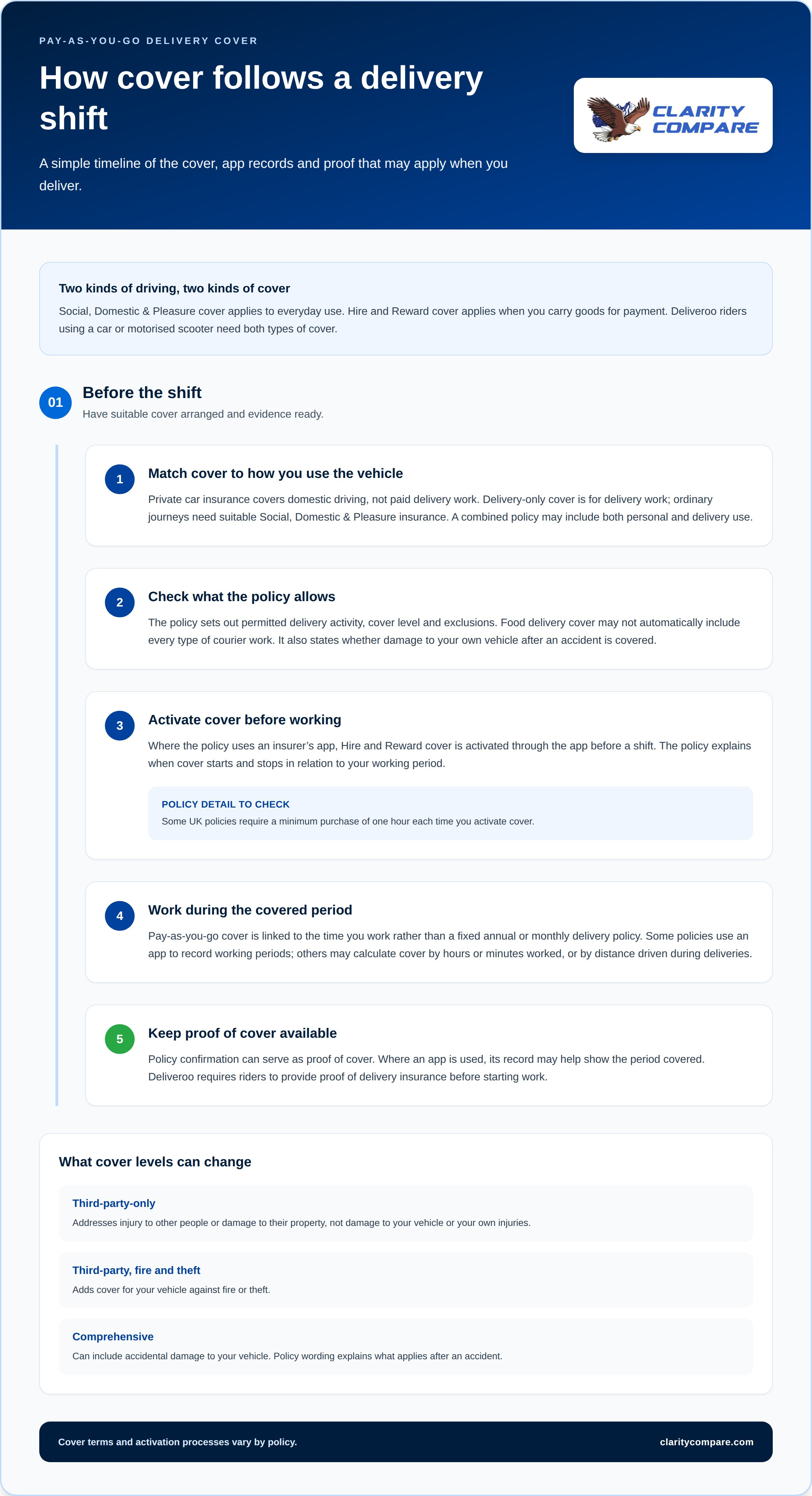
Delivery-only cover applies to delivery work, while combined cover includes both work and personal driving. Delivery-only cover does not include ordinary journeys, which require suitable Social, Domestic & Pleasure insurance. Deliveroo riders using a car or motorised scooter need both types of cover. Policies state which activities and cover levels are included, and whether damage to your vehicle after an accident is covered.
Pay-as-You-Go Cover Duration
Pay-as-you-go hire and reward cover is linked to the time you work, rather than a fixed annual or monthly delivery policy. Some UK policies use an app to track working periods, and some require a minimum purchase of one hour each time you activate cover. The policy sets out how cover starts and stops in relation to a delivery shift.
When Temporary Delivery Cover Helps
Temporary cover may suit a driver taking occasional delivery shifts rather than making deliveries regularly. For example, a car courier doing food deliveries on selected days may have cover tied to working periods. Standard van insurance doesn’t cover multiple paid deliveries, so a van used for courier work needs suitable courier insurance. The cover available depends on the type and pattern of delivery work.
Activating and Proving Your Cover
Where the policy uses an insurer’s app, hire and reward cover is activated through the app before a shift. The app may record when you’re working, helping show the period covered. Policy confirmation can serve as proof of cover. Deliveroo requires riders to provide proof of delivery insurance before starting work, so its platform requirements include having cover arranged and evidence ready first.
Why Do I Need Courier Car Insurance?
Private car insurance covers domestic driving, not paid delivery work. If you use your car to carry food or parcels for payment, you need insurance that covers courier or hire and reward activity. According to the UK legislation register, Section 143 of the Road Traffic Act is cited as requiring insurance for vehicles used on roads and in public places in the United Kingdom.
Food delivery insurance can cover paid fast-food orders, including pizza and Chinese food. Pay-as-you-go cover is also available for Amazon Flex drivers delivering parcels or food. The permitted activity matters: a policy covering food delivery may not automatically cover every type of courier work, so check its uses and exclusions.
Courier insurance is designed for delivery work. A private policy may not cover claims arising while you’re carrying goods for payment. Cover levels also differ. Third-party-only cover addresses injury to other people or damage to their property, not damage to your vehicle or your own injuries. Third-party, fire and theft adds cover for your vehicle against fire or theft, while comprehensive cover can include accidental damage to your vehicle. Read the policy wording to understand what applies after an accident.
Pay-as-you-go courier cover may calculate premiums by the hours or minutes worked, or by the distance driven during deliveries. Traditional courier insurance usually has a fixed annual or monthly structure. Your work pattern, vehicle details and driving history can affect how insurers assess cover. A valid UK driving licence and details of your vehicle and driving history are among the information needed for a quote.
According to the Driver and Vehicle Licensing Agency, an uninsured vehicle in the UK could result in a £100 fine. Before accepting a shift, confirm that your policy covers the goods, delivery activity and working period. Those details help you spot gaps between private use and paid work.
Eligible vehicles and driver ages
Eligibility for pay-as-you-go delivery insurance depends on both the driver and the vehicle. Policy terms set out which vehicles are eligible. A car or scooter used for takeaway deliveries will have its own vehicle and use criteria.
Age rules differ across van insurance products. Some UK van quotes may be available to drivers from age 17, while some insurers set minimum ages of 21 or 25. Separate product details say UK and EU licence holders aged 21 to 75 can be covered. Another set of eligibility requirements lists drivers aged between 21 and 70. These figures refer to different eligibility criteria, not one universal age range.
Your driving record can also affect whether you meet a policy’s requirements. One stated eligibility list requires no driving bans within the previous 60 months. A valid UK driving licence is among the details needed for a pay-as-you-go food delivery insurance application. The insurer will also need information about your vehicle and driving history.
Delivery platform rules matter too. Deliveroo requires proof of delivery insurance before a rider starts work. Amazon Flex drivers need Hire and Reward insurance alongside their personal Social, Domestic and Pleasure policy. So, paying only for cover while delivering still means arranging suitable protection for personal journeys. Flexible work hours don’t remove the need to match the policy to both uses.
Vehicle limits and driver criteria vary between policies. For example, a driver aged 20 meets an insurer’s minimum age of 17, but not a product requiring drivers to be at least 21. Likewise, a van over 3.5 tonnes falls outside the stated vehicle limit. Policy details also set out licence and delivery platform requirements.
Hire and reward insurance
Hire and reward cover applies when you transport goods for payment. Pay-as-you-go options link cover to delivery work, while the policy’s cover level determines what protection applies.
Insurers Offering Pay-as-You-Go Cover
Options vary by provider. Policies differ in the working periods covered and how activation is recorded. Some calculate payment by the hour or minute worked, or by distance driven while delivering. Policy terms may set a minimum activation period and explain how claims during a shift are handled. These features describe differences between policies beyond the payment method.
Policy wording can describe the delivery work covered. Takeaway orders and parcels differ in the goods transported, though both involve paid work. Cover terms may specify the types of delivery, vehicles and working hours included. A policy’s title alone doesn’t explain its limits or exclusions.
Amazon Flex drivers need Hire and Reward insurance alongside their personal Social, Domestic and Pleasure policy. Pay-as-you-go insurance is available for UK Amazon Flex drivers delivering parcels or food. This separates personal journeys from paid delivery work, so the policy needs to account for both uses. Policy documents may explain how each use is defined and what evidence is provided for active cover.
Insurance Cover Delivery Drivers Need
In the UK, paid delivery drivers need motor insurance that covers hire and reward use, as well as cover for ordinary personal driving. Social, Domestic and Pleasure insurance applies to everyday vehicle use, not delivery work. Deliveroo riders using a car or motorised scooter need both types of cover. Deliveroo also requires proof of delivery insurance before a rider starts working.
Policy features include the cover level, delivery activity, vehicle and activation process. Third-party-only cover protects against claims for injury to others or damage to their property, not damage to your own vehicle. Third-party, fire and theft adds protection for fire or theft. Comprehensive cover can include accidental damage to your vehicle, subject to policy terms. Compare courier car insurance quotes to explore available options.
Clarity Compare
Clarity Compare helps you compare insurance options and understand policy information. If your delivery routine changes, the vehicle use and working pattern you enter can shape which details matter when reviewing cover.
Clarity Compare provides access to an FCA-regulated insurance comparison service and may receive a fee or commission for referrals. This comparison service can help you review available insurance options; it does not provide regulated financial advice or direct insurance underwriting.
For questions about using Clarity Compare, contact Clarity Compare.
Make your next cover decision with clarity
Your delivery arrangements may change over time. You might take on a different type of work, change your vehicle or adjust how often you drive. Revisit your cover when these details change, and make sure the information you rely on still reflects your circumstances. Keeping a note of what has changed can help focus your review.
When considering delivery driver insurance pay as you go, look beyond whether the cover is arranged around shifts. The policy wording, permitted use and details you provide all matter to how well cover matches your work. Clarity Compare makes it easier to compare insurance options and understand policy information, helping you approach your decision with greater clarity.
Take the time you need to consider your options. If you’d like to discuss your next step, contact Clarity Compare.
Frequently Asked Questions
What You Get With Pay As You Go Cover?
Pay-as-you-go cover can protect a vehicle during paid delivery work, subject to the policy’s terms and exclusions. The precise protection depends on the cover selected and the risks it includes. For example, comprehensive cover can include damage to your vehicle after an accident, including when the accident is your fault. Policy terms set out whether fire, theft and vandalism are covered, and how claims are handled.
Does waiting at the restaurant count?
Waiting at a restaurant is covered only if the policy treats that time as part of the insured delivery period. A delay after accepting an order can leave you waiting before collection, so policy wording explains when cover begins and ends. The covered period may differ between insurers. Policy terms clarify how pauses, cancelled orders and gaps between jobs are treated.
How is pay as you go insurance cover determined?
Providers may base cover on recorded delivery activity, but the method and policy conditions determine what counts. A minimum activation period can affect a short shift, even if you finish deliveries sooner. Some policies require at least one hour of cover each time you activate them. Work patterns and how each policy records or rounds an active session are relevant policy conditions.
How does pay-as-you-go delivery driver insurance work in the UK?
Delivery driver insurance pay as you go is arranged around periods of paid work rather than a fixed delivery policy covering a set annual term. The policy sets out when cover is active for the delivery activity you’re undertaking. The policy documents, including the schedule and wording, identify the insured vehicle, permitted use and applicable conditions if you need to make a claim.
What cover periods apply to pay-as-you-go delivery driver insurance in the UK?
There isn’t one hourly or mileage cover period that applies to every UK delivery driver. The insurer’s terms and the cover arranged determine how a policy operates, so an hourly figure from one policy cannot automatically be compared with another. Policy documents set out the cover period and its terms, including any minimum cover period.
What affects the terms of pay-as-you-go delivery driver insurance?
The vehicle and the nature of the delivery work affect which policy terms apply. For example, courier cover is not standard cover for hazardous, dangerous or toxic materials. Longer-distance, single-destination jobs may require haulage insurance rather than courier cover. The goods, journey pattern and permitted use described in the policy determine the applicable conditions for delivery driver insurance pay as you go.